Introduction to Neural Networks
Neural networks are computational models inspired by the human brain's interconnected network of neurons.
- Consist of layers of interconnected nodes called neurons .
- Each neuron processes input and passes the output to the next layer.
- Capable of learning complex patterns from data.
- Used in various domains like computer vision, natural language processing, and more.
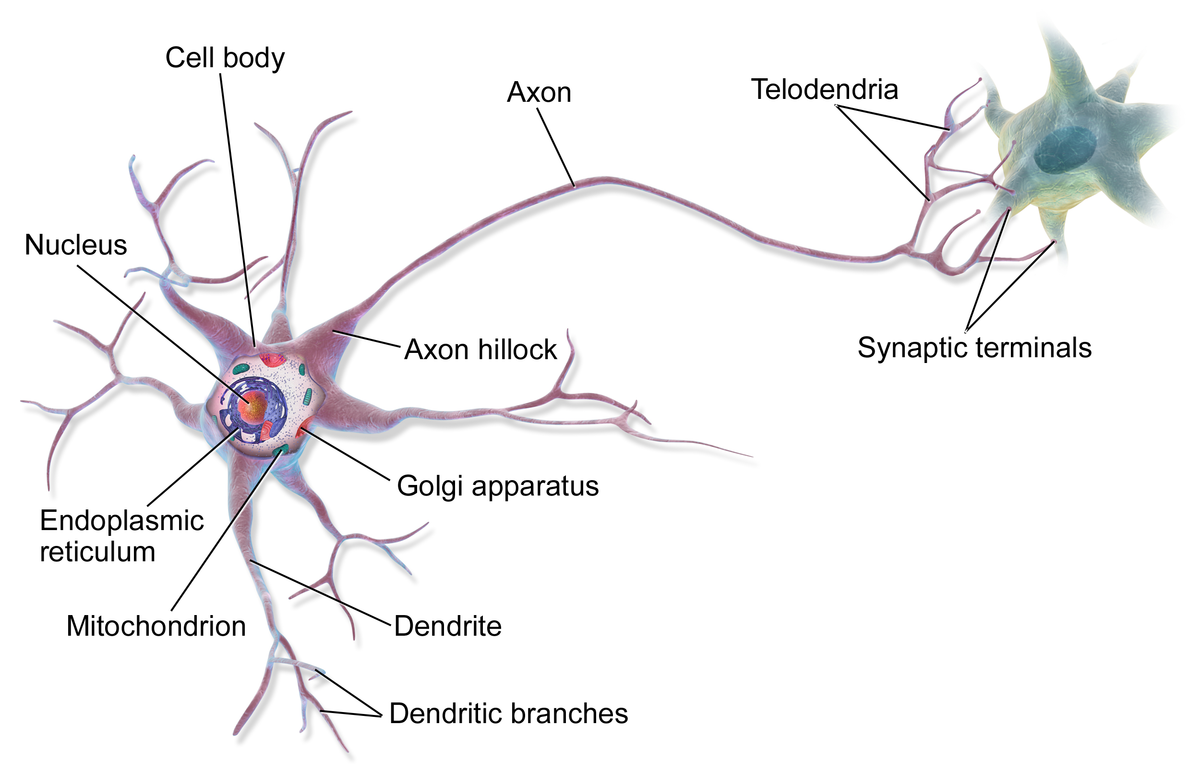
Artificial Neuron Model
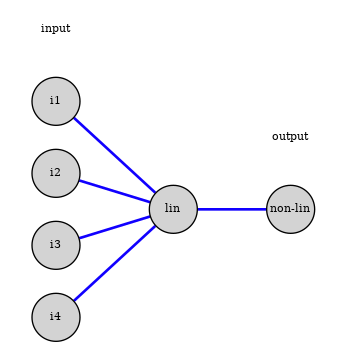
A modern neuron in a neural network performs two main operations:
- Linear Combination: Computes a weighted sum of inputs.
- Non-linear Activation: Applies an activation function to introduce non-linearity.
Mathematically:
$$ z = w_0 + \sum_{i=1}^{n} w_i x_i $$
$$ \text{output} = \phi(z) $$
where $\phi(z)$ is the activation function.
Anatomy of an Artificial Neuron
- Inputs represent features
- Weights determine importance
- Bias shifts the activation threshold
- Activation decides whether the neuron “fires”

Understanding the Bias Term
The bias allows the activation boundary to shift left or right:
- Without bias → the boundary always passes through origin
- With bias → network can fit more functions
This is equivalent to “intercept” in linear regression.
Mathematical Formulation of the Perceptron
Mathematically, the perceptron computes:
$$ z = w_0 + \vec{w} \cdot \vec{x} $$
$$ \text{output} = \phi(z) $$
where:
- $\vec{x}$ = input vector.
- $\vec{w}$ = weight vector.
- $w_0$ = bias term.
- $\phi(z)$ = activation function (e.g., step function).
The perceptron learning rule updates weights based on the error:
$$ w_j \leftarrow w_j + \eta (y - \hat{y}) x_j $$
where:
- $\eta$ = learning rate.
- $y$ = true label.
- $\hat{y}$ = predicted label.
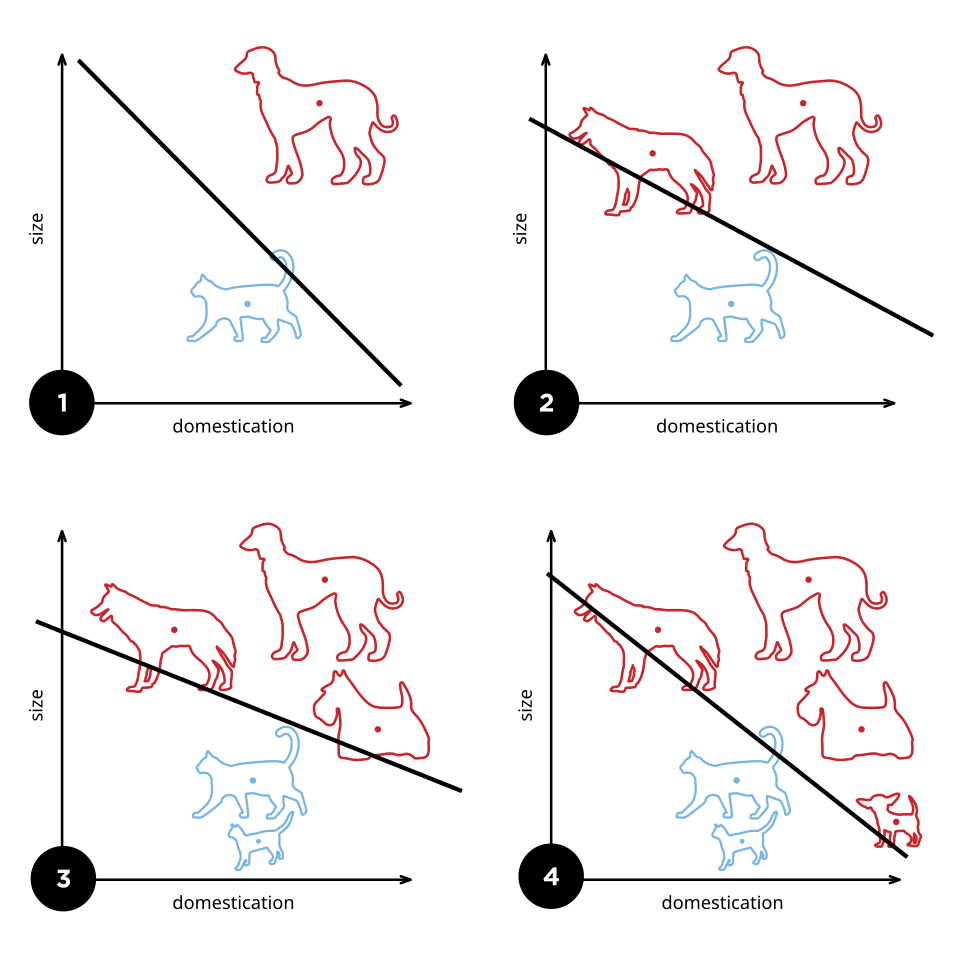
Perceptron Learning: Geometric View
- If a point is misclassified, move the boundary toward it
- Updates occur only when the model is wrong
- Each update rotates/ translates the decision boundary
Why Can’t the Perceptron Learn XOR?
Q: What prevents a single perceptron from learning XOR?
A: The classes are not linearly separable. No single line can divide them.
Motivates multi-layer networks.
Limitations of the Perceptron
The perceptron has significant limitations:
- Can only solve linearly separable problems.
- Cannot model complex, non-linear decision boundaries (e.g., XOR problem).
- Limited representational capacity.
- Led to the development of multi-layer networks to overcome these limitations.

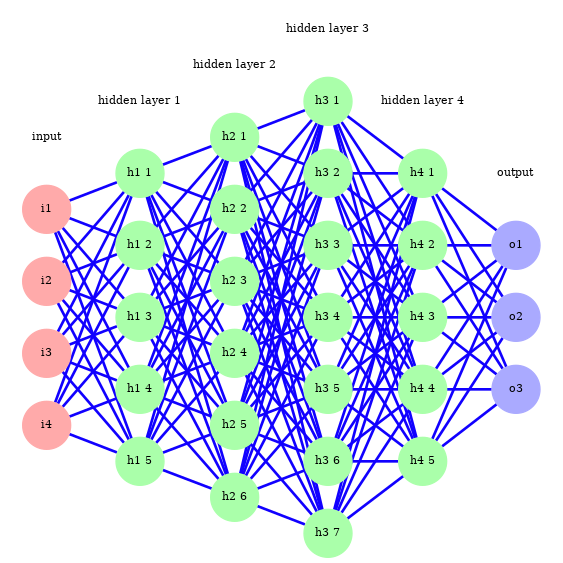
Universal Approximation
- MLPs can approximate any continuous function
- Given: enough neurons + enough weights
- Does NOT mean: easy to train, or efficient, or well-behaved
Deep Learning
Networks with a large number of layers are referred to as deep learning .
Advantages:
- Can learn hierarchical representations.
- Effective in processing high-dimensional data like images, speech, and text.
Challenges:
- Require large amounts of data.
- Computationally intensive training.
- Potential for overfitting.
Advances in hardware (GPUs, TPUs) and algorithms (e.g., optimization techniques) have made deep learning feasible.
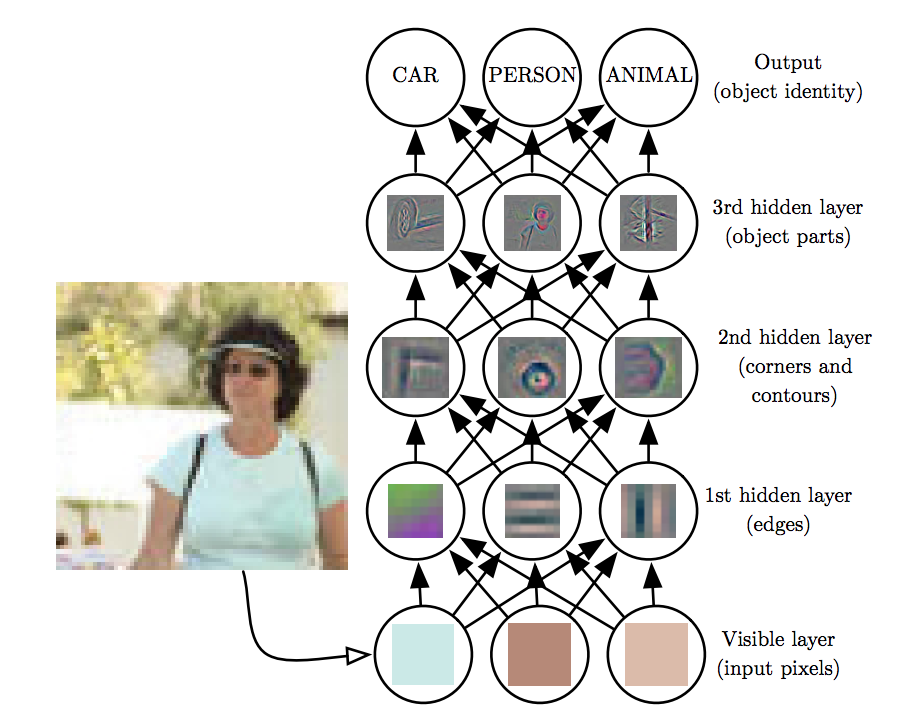
Deep Learning and Hierarchical Feature Learning
Deep learning leverages multiple layers to learn hierarchical representations:
- Lower Layers: Capture simple features like edges or textures.
- Middle Layers: Combine simple features to form more complex patterns.
- Higher Layers: Abstract high-level concepts relevant to the task.
This hierarchy enables neural networks to automatically learn features from raw data.
Training Neural Networks
Training involves adjusting weights to minimize a loss function:
- Initialize weights randomly or using specific initialization methods.
- Perform a forward pass to compute the output.
- Calculate the loss using a suitable loss function.
- Compute gradients via backpropagation.
- Update weights using an optimization algorithm.
- Repeat the process for multiple epochs.
Key concepts:
- Epoch: One complete pass through the training dataset.
- Batch Size: Number of samples processed before updating weights.
- Learning Rate: Controls the step size during weight updates.
Training Neural Networks
Training involves adjusting weights to minimize a loss function:
- Initialize weights randomly or using specific initialization methods.
- Perform a forward pass to compute the output.
- Calculate the loss using a suitable loss function.
- Compute gradients via backpropagation.
- Update weights using an optimization algorithm.
- Repeat the process for multiple epochs.
Weight Initialization Techniques
Proper weight initialization can help in faster convergence:
- Zero Initialization: Not recommended as it causes symmetry.
- Random Initialization: Small random values from a normal or uniform distribution.
- Xavier Initialization: Scales weights based on the number of input and output neurons.
- He Initialization: Similar to Xavier but designed for ReLU activation functions.
Avoiding vanishing or exploding gradients through appropriate initialization.
Training Neural Networks
Training involves adjusting weights to minimize a loss function:
- Initialize weights randomly or using specific initialization methods.
- a forward pass to compute the output.
- Calculate the loss using a suitable loss function.
- Compute gradients via backpropagation.
- Update weights using an optimization algorithm.
- Repeat the process for multiple epochs.
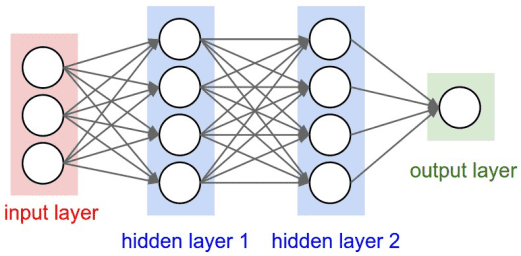
Feedforward Process
The feedforward process involves propagating inputs through the network to generate an output.
- Input data is presented to the input layer.
- Each neuron computes a weighted sum of its inputs and applies an activation function.
- The outputs of one layer become the inputs to the next layer.
- The final output layer produces the network's prediction.
This process is used during both training and inference phases.
Feedforward Process
Activation Functions
Activation functions introduce non-linearity into the neural network, allowing it to learn complex patterns.
Common activation functions include:
- Step Function
- Sigmoid Function
- Tanh Function
- ReLU (Rectified Linear Unit)
- Leaky ReLU
- ELU (Exponential Linear Unit)
- Softmax Function
Selection of activation functions can significantly impact the network's performance.
Why Do We Need Non-Linear Functions?
Without activation functions, a neural network is just a linear model:
- Composing linear layers → still linear
- Cannot form curved boundaries
- Cannot “bend” feature space
Non-linear activations allow networks to shape flexible decision regions.
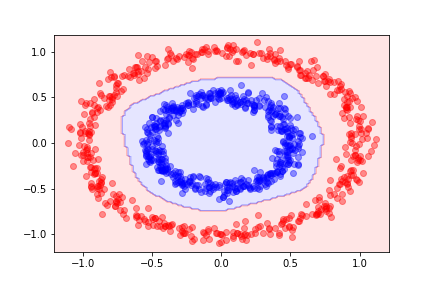
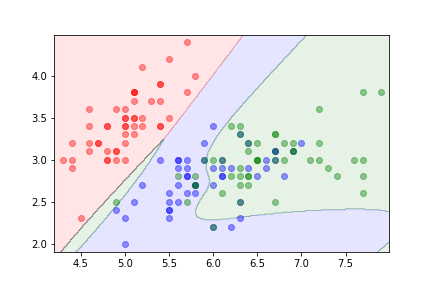
Effect of Non-Linearity: Visual Example
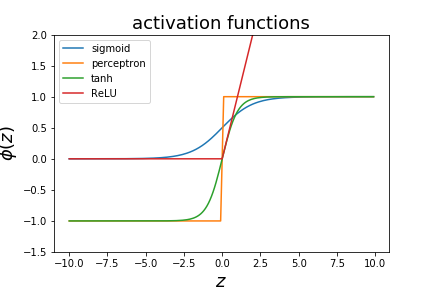
Different activation functions create different transformations:
- Sigmoid compresses values into (0,1)
- Tanh compresses into (-1,1)
- ReLU removes negative values
This changes the geometry of the feature space.
Activation Functions
- Formula:
$$\phi(x) = \max(0, x)$$
- Characteristics:
- Outputs zero for negative inputs and linear for positive inputs.
- Simple and computationally efficient.
- Helps mitigate vanishing gradient problems.
- Can suffer from "dying ReLUs" where neurons stop activating.
Advanced Activation Functions
- Leaky ReLU
- Formula:
$$\phi(x) = \begin{cases} x & \text{if } x \geq 0 \\ \alpha x & \text{if } x < 0 \end{cases}$$
Typically, \( \alpha \) is a small constant like 0.01. - Characteristics:
- Allows a small, non-zero gradient when \( x < 0 \).
- Addresses the "dying ReLU" problem.
Non-linear activation functions
There are different decision functions that can be used.
- the perceptron used a step function
- logistic regression uses the sigmoid function
- one can also use $\phi(z)=tanh(z)$ as a decision function
- various variations on the hinge function (ReLU)
When to Use Each Activation Function
- Sigmoid: binary classification output
- Tanh: zero-centred hidden layers
- ReLU: most common default for hidden layers
- Softmax: multi-class probabilities
Sane default: ReLU (hidden layers) + Softmax (output).
Why did ReLU become the default?
- No saturation for positive inputs
- Cheap to compute
- Helps avoid vanishing gradients
- Works surprisingly well in practice
Training Neural Networks
Training involves adjusting weights to minimize a loss function:
- Initialize weights randomly or using specific initialization methods.
- Perform a forward pass to compute the output.
- Calculate the loss using a suitable loss function.
- Compute gradients via backpropagation.
- Update weights using an optimization algorithm.
- Repeat the process for multiple epochs.
Loss Functions
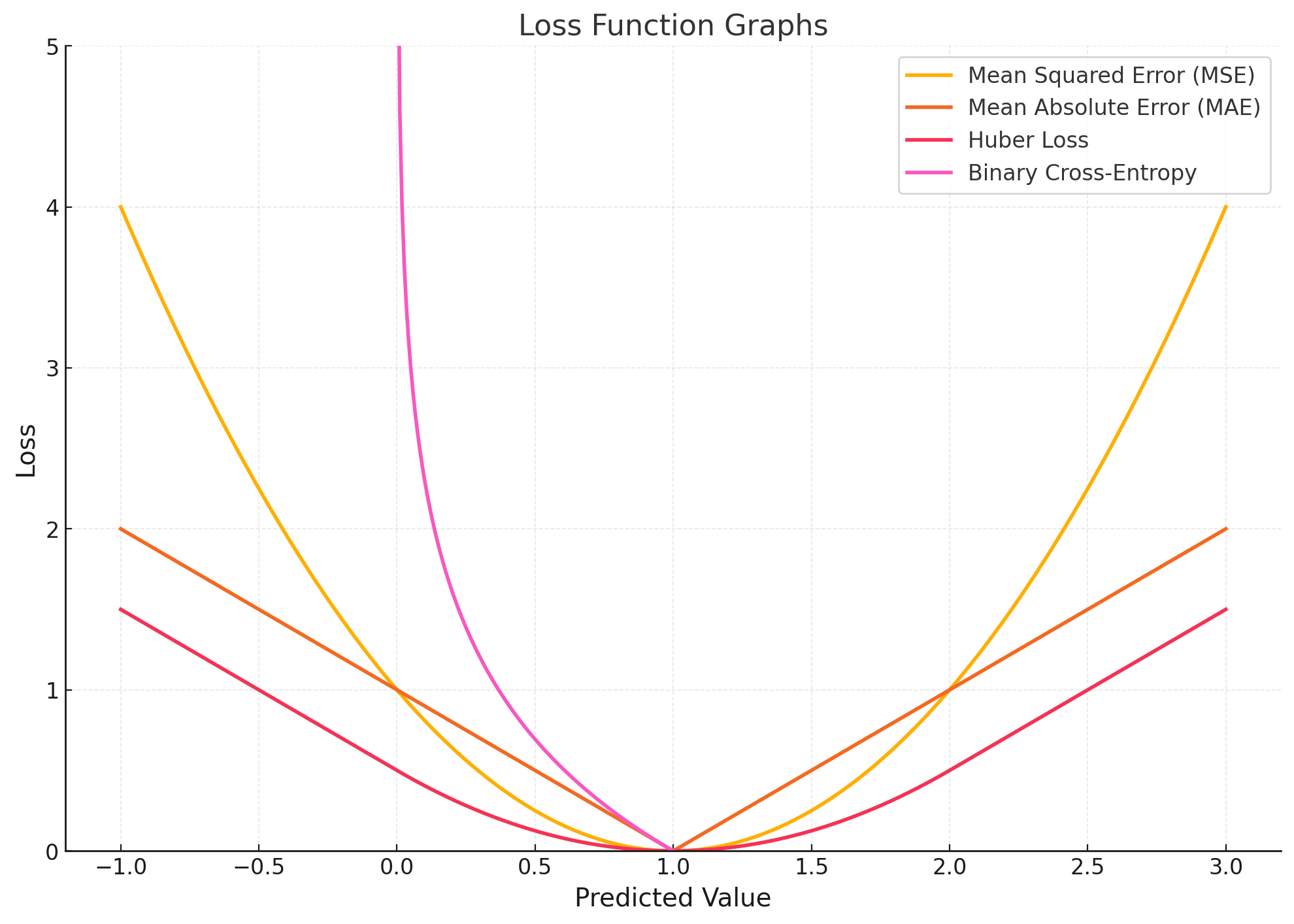
Loss functions quantify the difference between the predicted output of the network and the true output. They are crucial for training neural networks using backpropagation.
Common loss functions include:
- Mean Squared Error (MSE)
- Mean Absolute Error (MAE)
- Binary Cross-Entropy Loss (Log Loss)
- Categorical Cross-Entropy Loss
- Hinge Loss
- Kullback-Leibler Divergence Loss (KL Divergence)
Loss Functions
- Mean Squared Error (MSE)
- Formula:
$$L_{\text{MSE}} = \frac{1}{n} \sum_{i=1}^{n} (y_i - \hat{y}_i)^2$$
- Explanation:
- \( y_i \): True value.
- \( \hat{y}_i \): Predicted value.
- Measures the average squared difference between predictions and actual values.
- Usage:
- Commonly used in regression problems.
- Penalizes larger errors more than smaller ones.
- Formula:
Loss Functions
- Formula:
$$L_{\text{MAE}} = \frac{1}{n} \sum_{i=1}^{n} |y_i - \hat{y}_i|$$
- Explanation:
- Measures the average absolute difference between predictions and actual values.
- Usage:
- Used in regression problems where outliers are less significant.
- Less sensitive to outliers compared to MSE.
Loss Functions
- Formula:
$$L_{\text{Binary}} = -\frac{1}{n} \sum_{i=1}^{n} [ y_i \log(\hat{y}_i) + (1 - y_i) \log(1 - \hat{y}_i) ]$$
- Explanation:
- Used for binary classification tasks.
- Penalizes the divergence between predicted probabilities and actual labels.
- Usage:
- Applicable when outputs are probabilities (using sigmoid activation in the output layer).
Loss Functions
- Formula:
$$L_{\text{Categorical}} = -\sum_{i=1}^{n} \sum_{k=1}^{K} y_{i,k} \log(\hat{y}_{i,k})$$
- Explanation:
- \( y_{i,k} \): Binary indicator (0 or 1) if class label \( k \) is the correct classification for sample \( i \).
- \( \hat{y}_{i,k} \): Predicted probability that sample \( i \) is of class \( k \).
- Used for multi-class classification tasks.
- Usage:
- Often used with softmax activation in the output layer.
Loss Functions
- Formula:
$$L_{\text{Hinge}} = \frac{1}{n} \sum_{i=1}^{n} \max(0, 1 - y_i \hat{y}_i)$$
- Explanation:
- Used primarily for "maximum-margin" classification, especially with support vector machines.
- \( y_i \) should be -1 or 1, representing class labels.
- Usage:
- Can be used in neural networks for binary classification.
Loss Functions
- Formula:
$$L_{\text{KL}} = \sum_{i=1}^{n} y_i \log\left( \frac{y_i}{\hat{y}_i} \right)$$
- Explanation:
- Measures how one probability distribution diverges from a second, expected probability distribution.
- Usage:
- Used in applications like variational autoencoders.
Loss Functions
Role in Backpropagation:
- The loss function calculates the error between the network's predictions and the true values.
- The computed loss is then used to calculate gradients during backpropagation.
- The gradients are propagated backward through the network to update the weights.
Understanding and selecting the appropriate loss function is critical for effective training of neural networks.
Loss Landscapes
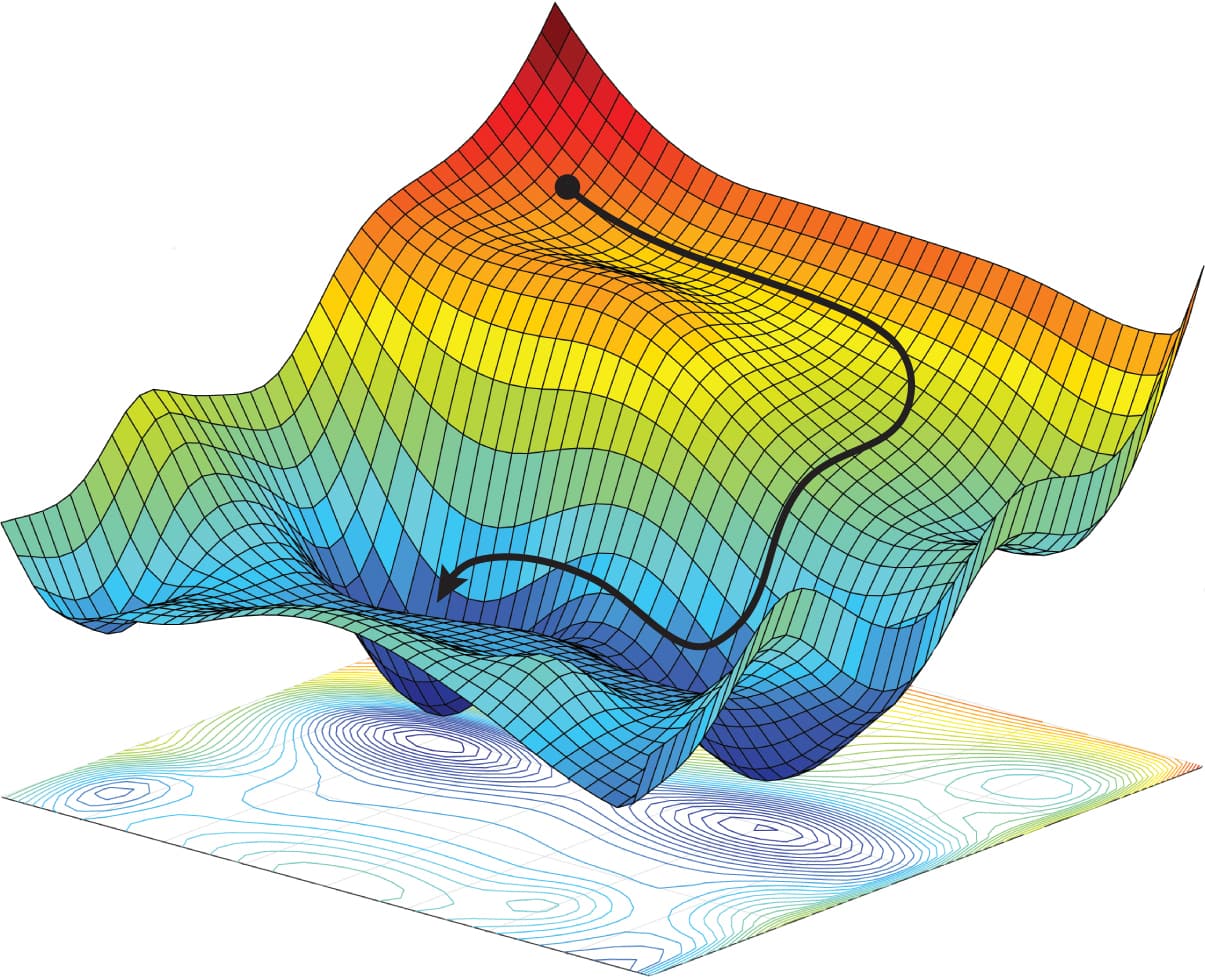
Neural network training often resembles navigating a complex landscape:
- Many valleys, ridges, plateaus
- SGD follows the local slope
- Momentum smooths the path
Training Neural Networks
Training involves adjusting weights to minimize a loss function:
- Initialize weights randomly or using specific initialization methods.
- Perform a forward pass to compute the output.
- Calculate the loss using a suitable loss function.
- Compute gradients via backpropagation.
- Update weights using an optimization algorithm.
- Repeat the process for multiple epochs.
What Is a Gradient?
- Measures how much the loss changes with respect to a weight
- Tells us which direction improves performance
- Large gradient → big adjustment
- Small gradient → slow learning
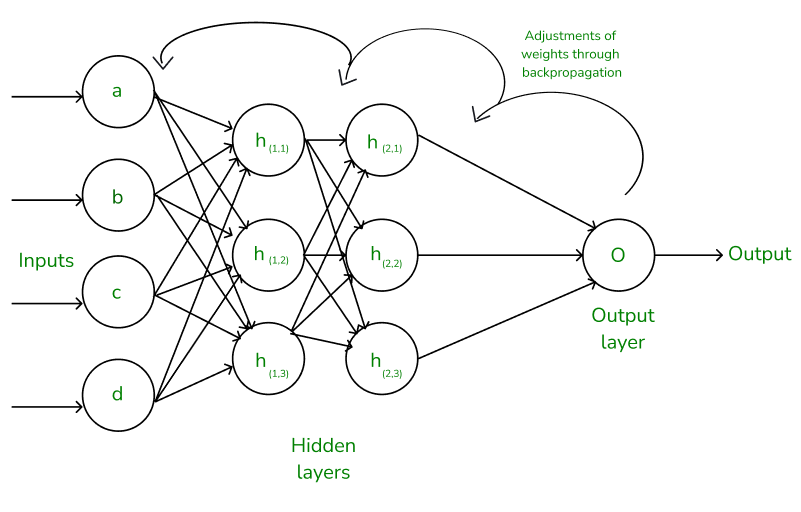
Backpropagation: Core Idea
Goal: compute how much each weight contributed to the final error.
- Forward pass: compute predictions
- Backward pass: compute gradients of loss wrt every weight
- Update: subtract learning rate × gradient
The key mathematical tool: the chain rule.
Backprop connects derivatives layer by layer from output → input.
Backpropagation Through a Single Neuron
For a neuron:
$$ z = w_0 + \sum_i w_i x_i,\quad a = \phi(z) $$
Its gradient contribution is:
- \( \frac{\partial L}{\partial a} \): depends on loss function
- \( \frac{\partial a}{\partial z} = \phi'(z) \): activation derivative
- \( \frac{\partial z}{\partial w_i} = x_i \): inputs
So each weight update is:
$$ \Delta w_i = - \eta \frac{\partial L}{\partial a} \, \phi'(z) \, x_i $$
Three factors: error × activation slope × input.
Backpropagation Through Layers
For hidden layers, gradients include contributions from all later layers.
The error signal for neuron \( j \) in layer \( l \) is:
$$ \delta_j^{(l)} = \phi'(z_j^{(l)}) \sum_k w_{jk}^{(l+1)} \delta_k^{(l+1)} $$
- \( \delta^{(l)} \): “error signal” flowing backwards
- \( w_{jk}^{(l+1)} \): weights from neuron j → next layer neurons
- Sum spreads responsibility across paths
This is why multi-layer backprop requires careful tracking of all derivatives.
Training Neural Networks
Training involves adjusting weights to minimize a loss function:
- Initialize weights randomly or using specific initialization methods.
- Perform a forward pass to compute the output.
- Calculate the loss using a suitable loss function.
- Compute gradients via backpropagation.
- Update weights using an optimization algorithm.
- Repeat the process for multiple epochs.
Gradient Descent
Gradient descent is the optimization algorithm used to minimize the loss function.
Update rule:
$$ w_{ij} = w_{ij} - \eta \frac{\partial J}{\partial w_{ij}} $$
where:
- $\eta$ = learning rate.
- $\frac{\partial J}{\partial w_{ij}}$ = gradient of the loss with respect to weight $w_{ij}$.
Variants:
- Batch Gradient Descent
- Stochastic Gradient Descent (SGD)
- Mini-Batch Gradient Descent
What happens if the learning rate is:
- Too small?
- Too large?
Optimization Algorithms
Various optimization algorithms improve training efficiency and convergence:
- Stochastic Gradient Descent (SGD): Updates weights using individual samples.
- Momentum: Accelerates SGD by considering past gradients.
- Adagrad: Adapts learning rate based on past gradients.
Choice of optimizer can significantly affect training performance.
Optimization Algorithms
Various optimization algorithms improve training efficiency and convergence:
- Stochastic Gradient Descent (SGD)
- Update Rule:
$$w_{t+1} = w_t - \eta \nabla L(w_t; x_i, y_i)$$
- Explanation:
- Updates weights using individual samples \( (x_i, y_i) \).
- \( \eta \) is the learning rate.
- \( \nabla L(w_t; x_i, y_i) \) is the gradient of the loss function at time \( t \).
- Characteristics:
- Introduces noise due to sampling, which can help escape local minima.
- Can be slow to converge near minima.
- Update Rule:
Optimization Algorithms
Momentum
- Update Rule:
$$\begin{align*} v_{t} & = \gamma v_{t-1} + \eta \nabla L(w_t) \\ w_{t+1} & = w_t - v_{t} \end{align*}$$
- Explanation:
- \( v_t \) is the velocity (accumulated gradient).
- \( \gamma \) is the momentum coefficient (typically between 0 and 1).
- Accelerates SGD by smoothing gradients over time.
- Characteristics:
- Helps navigate ravines in the loss surface.
- Can overshoot minima if \( \gamma \) is too high.
Optimization Algorithms
- Update Rule:
$$\begin{align*} G_t & = G_{t-1} + \nabla L(w_t)^2 \\ w_{t+1} & = w_t - \frac{\eta}{\sqrt{G_t + \epsilon}} \nabla L(w_t) \end{align*}$$
- Explanation:
- \( G_t \) is the sum of the squares of past gradients (element-wise).
- \( \epsilon \) is a small constant to prevent division by zero (e.g., \( 10^{-8} \)).
- Adapts the learning rate for each parameter individually.
- Characteristics:
- Good for sparse data.
- Learning rate diminishes over time, which can halt training prematurely.
Training Neural Networks
Training involves adjusting weights to minimize a loss function:
- Initialize weights randomly or using specific initialization methods.
- Perform a forward pass to compute the output.
- Calculate the loss using a suitable loss function.
- Compute gradients via backpropagation.
- Update weights using an optimization algorithm.
- Repeat the process for multiple epochs.
Challenges in Training Deep Networks
Deep networks introduce specific challenges:
- Vanishing Gradients: Gradients become very small, slowing down learning.
- Exploding Gradients: Gradients grow exponentially, causing instability.
- Overfitting: Model performs well on training data but poorly on unseen data.
- Computational Complexity: Increased number of parameters requires more computational resources.
Strategies to mitigate these issues include activation function choices, gradient clipping, and regularization.
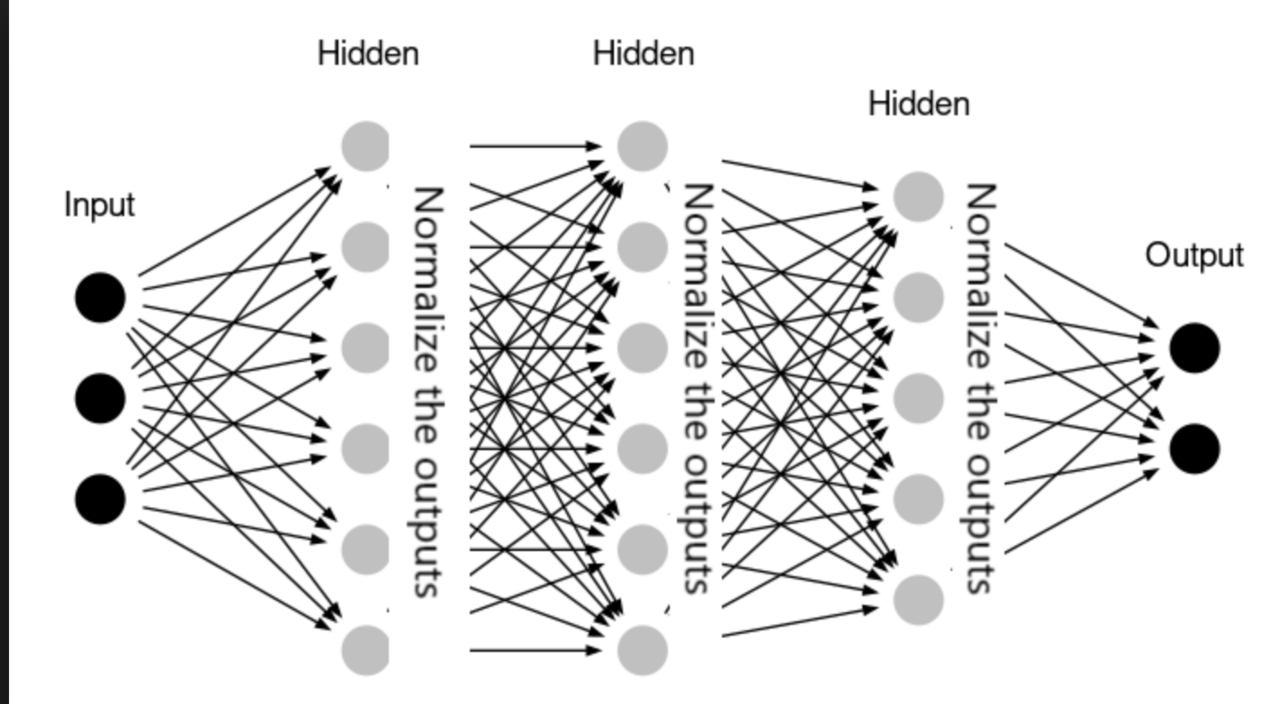
Batch Normalization
Batch normalization is a technique to improve training speed and stability:
- Normalizes the input of each layer to have zero mean and unit variance.
- Reduces internal covariate shift.
- Allows for higher learning rates.
- Acts as a form of regularization.
Introduced by Sergey Ioffe and Christian Szegedy in 2015.
Regularization Techniques
To prevent overfitting, we use regularization methods:
- L1 and L2 Regularization: Add penalty terms to the loss function.
- Dropout: Randomly drop units during training to prevent co-adaptation.
- Early Stopping: Stop training when validation loss starts to increase.
- Data Augmentation: Increase the size of the training data by transformations.
- Ensemble Methods: Combine multiple models to improve generalization.
Regularization helps in building models that generalize well to new data.
Practical Considerations
Important aspects to consider when working with neural networks:
- Hyperparameter Tuning: Selecting learning rates, batch sizes, number of layers, etc.
- Data Preprocessing: Normalization, scaling, and handling missing data.
- Hardware Acceleration: Utilizing GPUs and TPUs for faster computation.
- Frameworks and Libraries: TensorFlow, PyTorch, Keras, etc.
- Model Interpretability: Understanding and explaining model decisions.
These factors can significantly impact the performance and usability of neural network models.
Network Architectures
Neural networks are constructed by connecting artificial neurons in various configurations.
Types of network architectures:
- Feedforward Neural Networks: Information moves only in one direction, from input to output.
- Convolutional Neural Networks (CNNs): Specialized for processing grid-like data such as images.
- Recurrent Neural Networks (RNNs): Designed for sequential data, with loops to allow information to persist.
- Autoencoders: Used for unsupervised learning of efficient codings.
- Generative Adversarial Networks (GANs): Consist of generator and discriminator networks for data generation.
- Transformer Networks: Utilize self-attention mechanisms, prominent in NLP tasks.
Each architecture is tailored for specific types of data and tasks.
Advanced Topics in Deep Learning
Exploring cutting-edge developments in deep learning:
- Attention Mechanisms: Allow models to focus on specific parts of the input.
- Transfer Learning: Leveraging pre-trained models for new tasks.
- Generative Models: GANs and Variational Autoencoders (VAEs).
- Self-Supervised Learning: Learning representations from unlabeled data.
- Reinforcement Learning: Training agents to make decisions through rewards.
These topics represent the forefront of research and applications in deep learning.
Examples and Applications
Neural networks are used in various fields:
- Computer Vision: Image classification, object detection, image segmentation.
- Natural Language Processing: Language translation, sentiment analysis, question answering.
- Speech Recognition: Voice assistants, transcription services, speech synthesis.
- Healthcare: Disease prediction, medical image analysis, personalized medicine.
- Finance: Fraud detection, stock price prediction, algorithmic trading.
- Autonomous Vehicles: Perception, decision-making, and control systems.
These applications showcase the versatility and impact of neural networks.
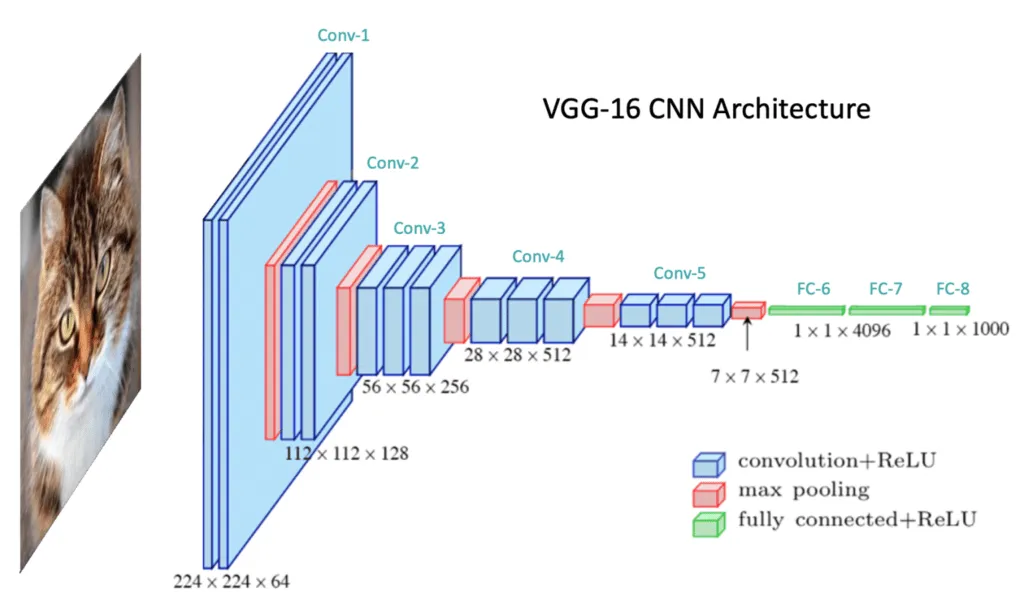
Case Study: Convolutional Neural Networks
Understanding CNNs through image classification tasks:
- Convolution Layers: Extract spatial features using filters.
- Pooling Layers: Reduce spatial dimensions and control overfitting.
- Fully Connected Layers: Perform classification based on extracted features.
- Applications: Used in models like AlexNet, VGGNet, ResNet.
Why Use Convolutions?
Fully-connected layers do not scale to images:
- MNIST: 28×28 inputs → 784 weights per neuron
- ImageNet: 224×224×3 → 150,528 inputs per neuron!
- Fully-connected layers ignore spatial structure
Convolutions exploit local patterns and weight sharing.
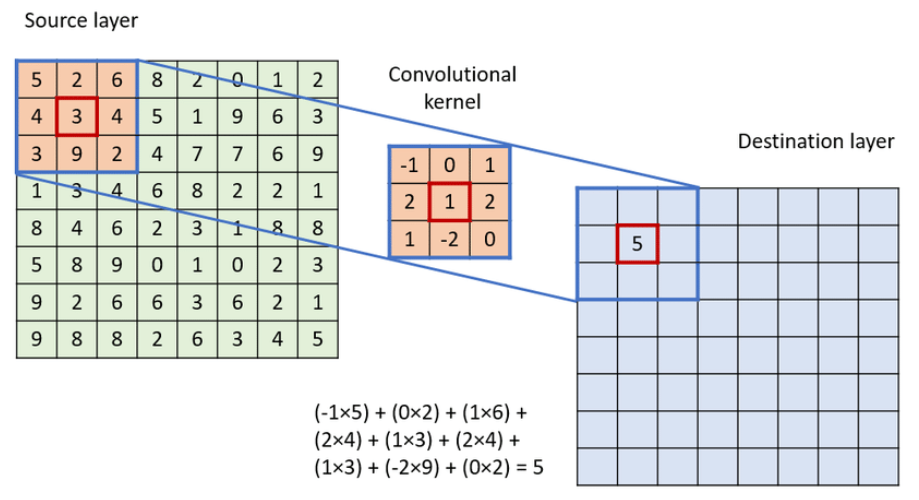
What Is a Convolution?
A small filter (e.g., 3×3) slides across the image:
- Computes weighted combinations of local pixels
- Detects edges, textures, patterns
- Weights reused everywhere → translation invariance
Conclusion
Neural networks are powerful tools for modeling complex patterns in data.
Key takeaways:
- They consist of interconnected neurons with activation functions.
- Can model non-linear relationships using hidden layers.
- Training involves feedforward and backpropagation processes.
- Regularization is essential to prevent overfitting.
- They have widespread applications across various domains.
- Continuous advancements are expanding their capabilities.
Understanding the fundamentals allows for further exploration into advanced topics.
Thank you for your attention!